

NVIDIA Stock Crash and 31% Rebound in November 2026
NVIDIA stock, Jensen Huang, AI stocks, Semiconductor selloff
NVIDIA stock (NASDAQ: NVDA) fell 37.9% from its November 2 close to its November 20 close, then rebounded 31.48% on November 23, when Jensen Huang returned as CEO. The semiconductor selloff accounted for much of the November 20 drop in our model. On reinstatement day, NVIDIA rose 19.29 to 20.97 percentage points more than two benchmark models predicted. That puts the market-cap gain above the benchmarks at roughly $589 billion to $641 billion. Nasdaq historical prices · NVIDIA’s reinstatement release
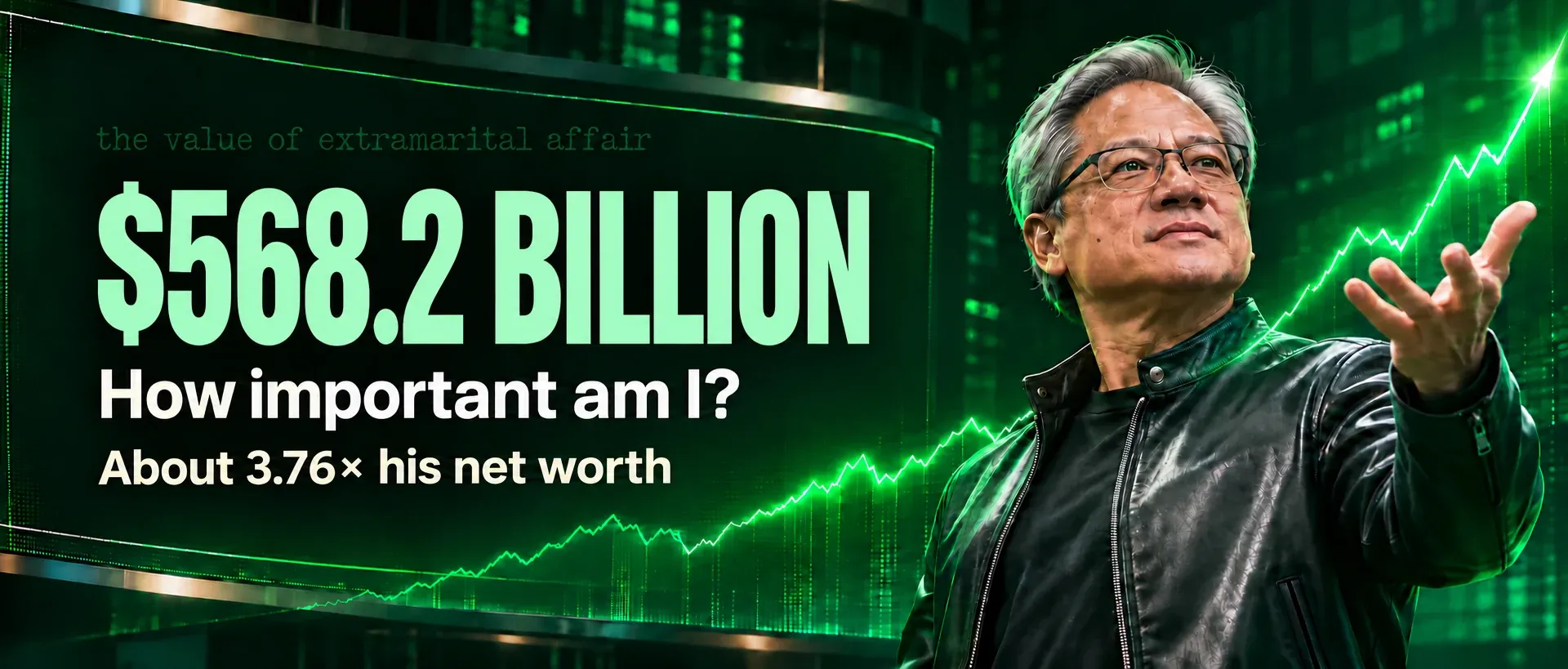
The $568.2 billion on the cover is an illustrative midpoint from the original study. The departure and return estimates that inform it are shown below.
Why did NVIDIA stock crash?
On November 20, NVIDIA closed down 14.01%. The VanEck Semiconductor ETF (SMH) fell 10.60%, and all seven semiconductor peers in our basket fell more than 3%. The basket lost 10.12% on an equal-weight basis, about 3.9 percentage points less than NVIDIA. The S&P 500 ETF (SPY) fell 3.64%. Yahoo Finance SMH history · StockQuote INTC history
| Security or benchmark | Nov. 20 close-to-close return |
|---|---|
| NVIDIA (NVDA) | −14.01% |
| Semiconductor ETF (SMH) | −10.60% |
| Seven semiconductor peers, equal weighted | −10.12% |
| Micron (MU) | −13.89% |
| AMD | −13.25% |
| Broadcom (AVGO) | −12.19% |
| S&P 500 ETF (SPY) | −3.64% |
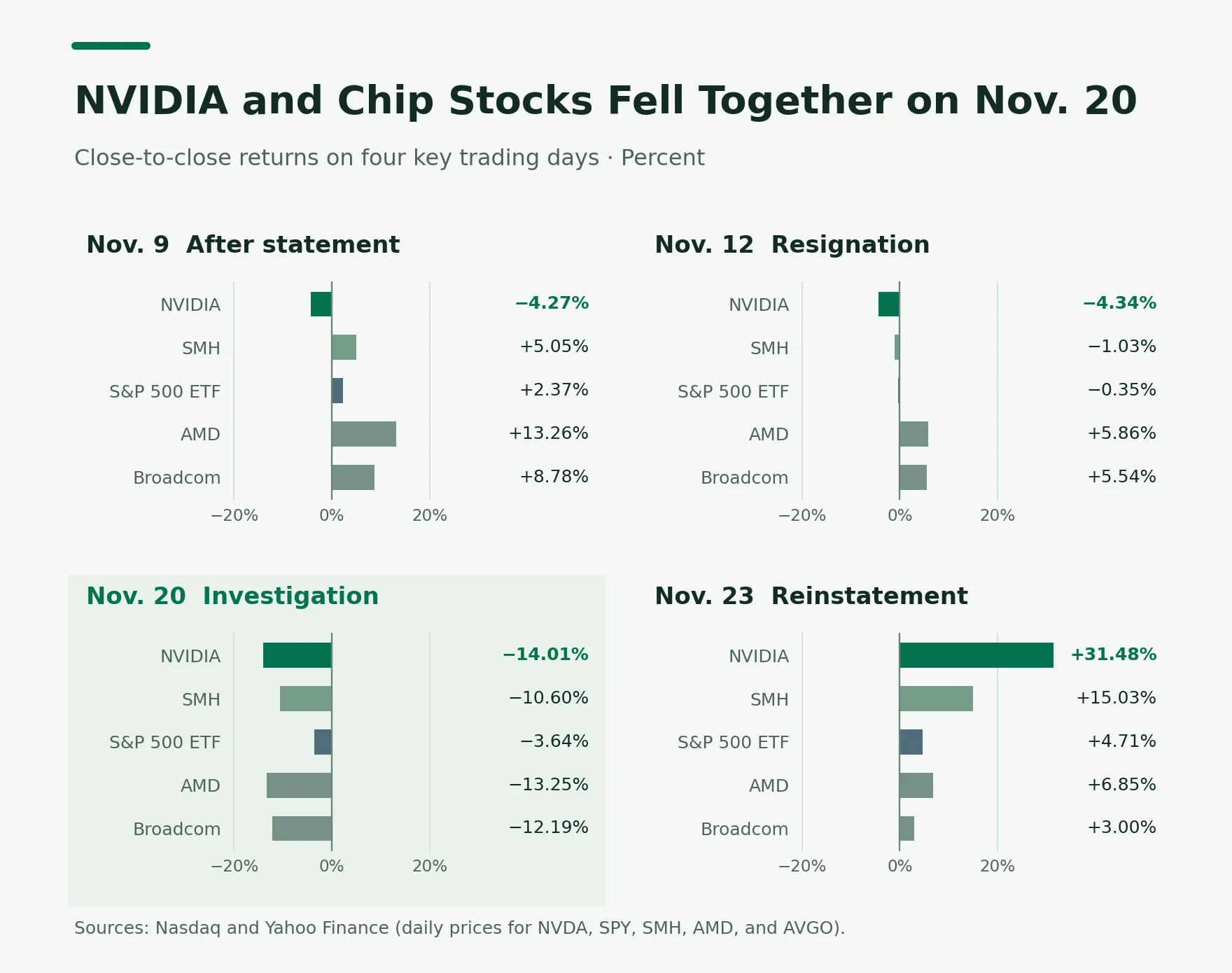
A model fitted before November using SPY and the seven-chip peer basket predicted a 7.89% decline, about 56% of NVIDIA’s actual drop. The remaining 6.12 percentage points equate to roughly $217.2 billion in abnormal market-cap loss, using the November 19 closing market cap under the study’s 24.33 billion-share assumption.
November 20 also brought a Reuters report about an SEC probe into potential accounting issues. Anthropic’s Nasdaq debut the previous day provides context for the broader repricing of AI stocks. The model does not estimate the contribution of either development. Reuters on the SEC probe, via Investing.com · Anthropic’s IPO pricing announcement
When did Jensen Huang resign and return?
NVIDIA’s board launched an independent review after public reporting and Huang’s November 8 statement. The board accepted his resignation on November 11 and announced it on November 12, naming CFO Colette Kress interim CEO. On a November 17 earnings call, the company signaled it had no plan to bring him back. The board reinstated him on November 22 and announced the decision before the market opened on November 23. ABC News on the review · Resignation Form 8-K · Earnings call coverage · Reinstatement Form 8-K
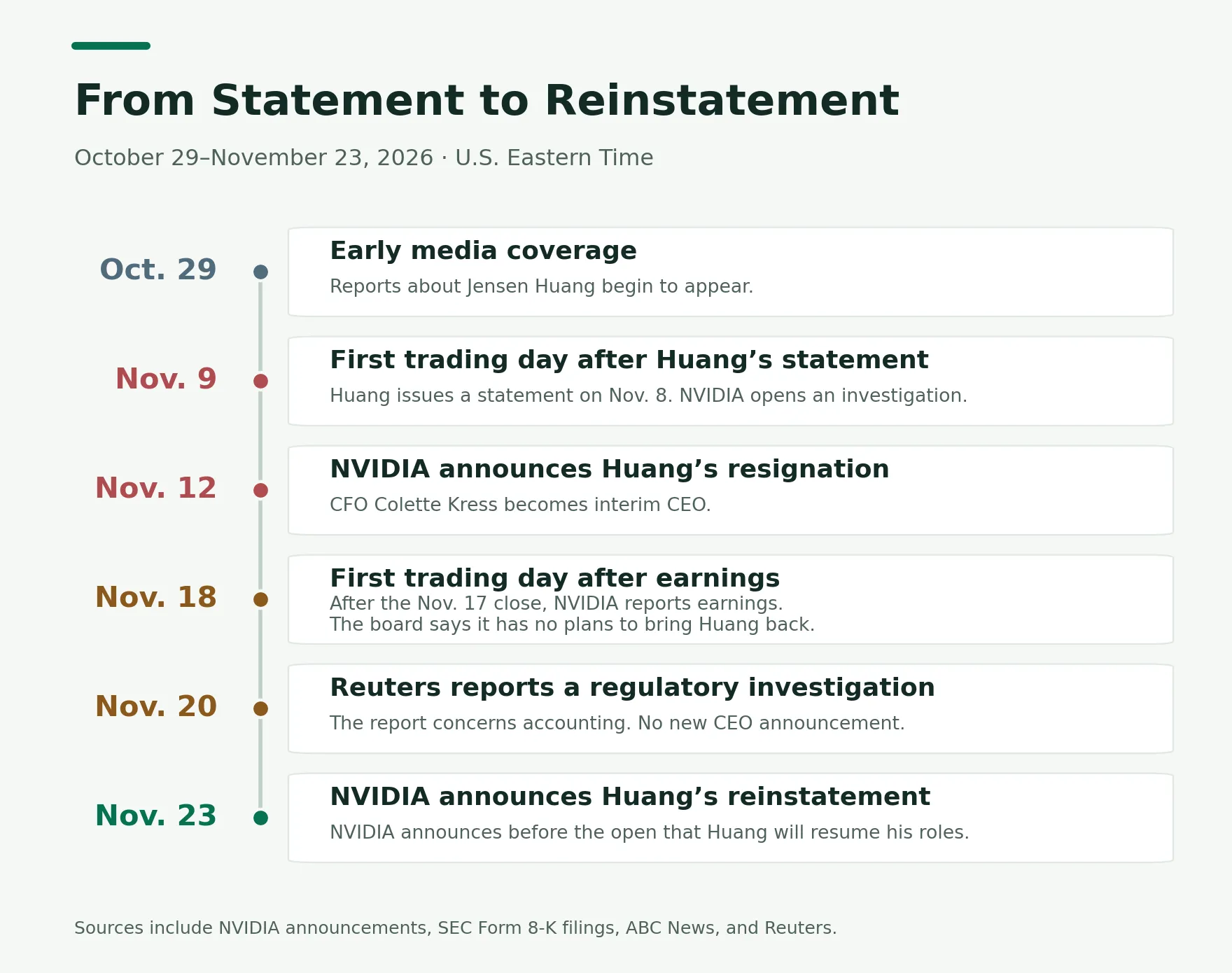
NVIDIA said the board voted unanimously after discussions with Huang. It said input from senior U.S. government officials gave it confidence that the reinstatement posed no national security risk, and that its independent committee’s investigation would continue. NVIDIA’s board statement filed with the SEC
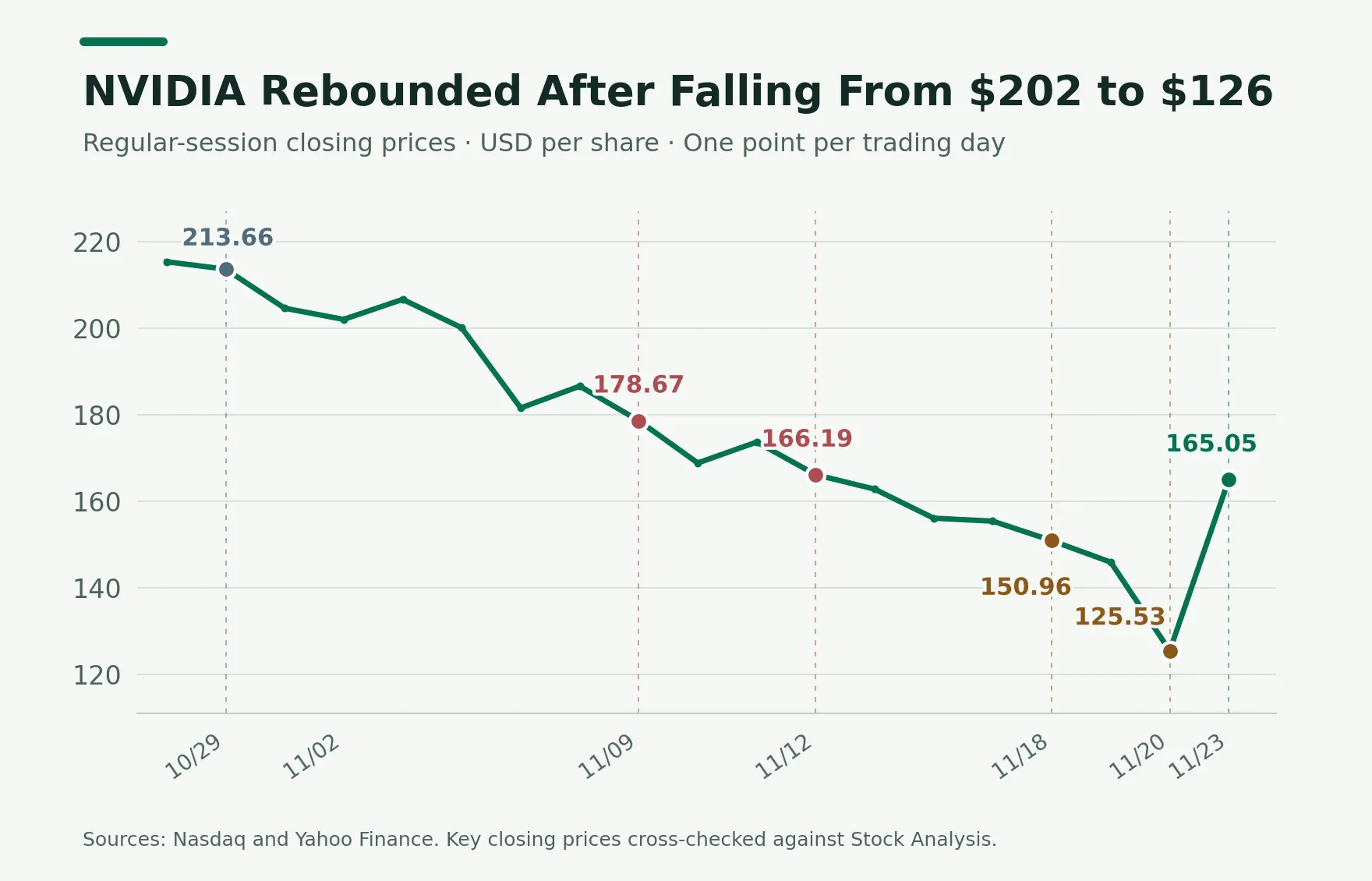
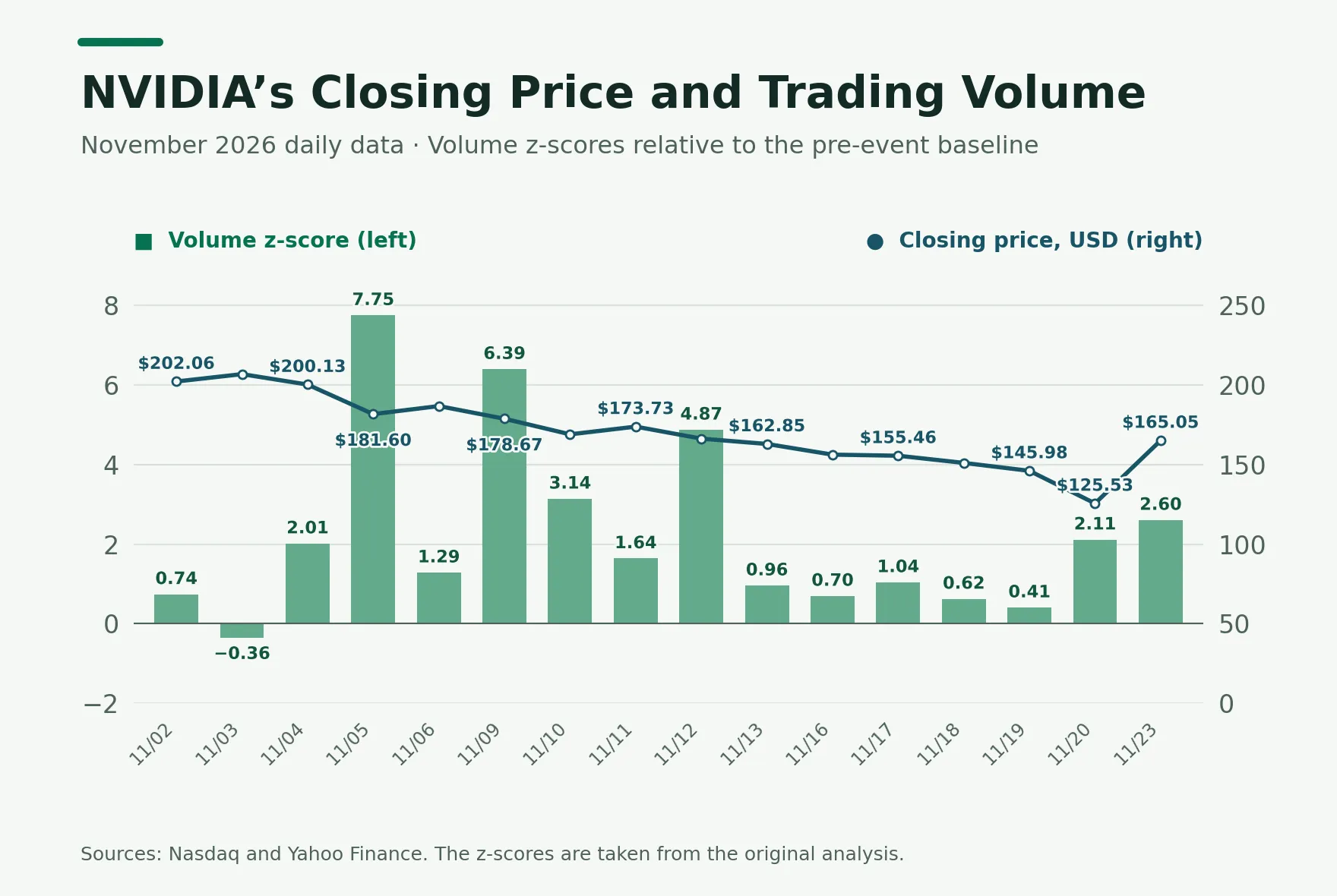
The rally lifted NVDA from $125.53 to $165.05. Even after the rebound, it was still 18.3% below the November 2 close of $202.06. Nasdaq historical prices · Stock Analysis historical prices
Were institutions positioning ahead of the NVIDIA selloff?
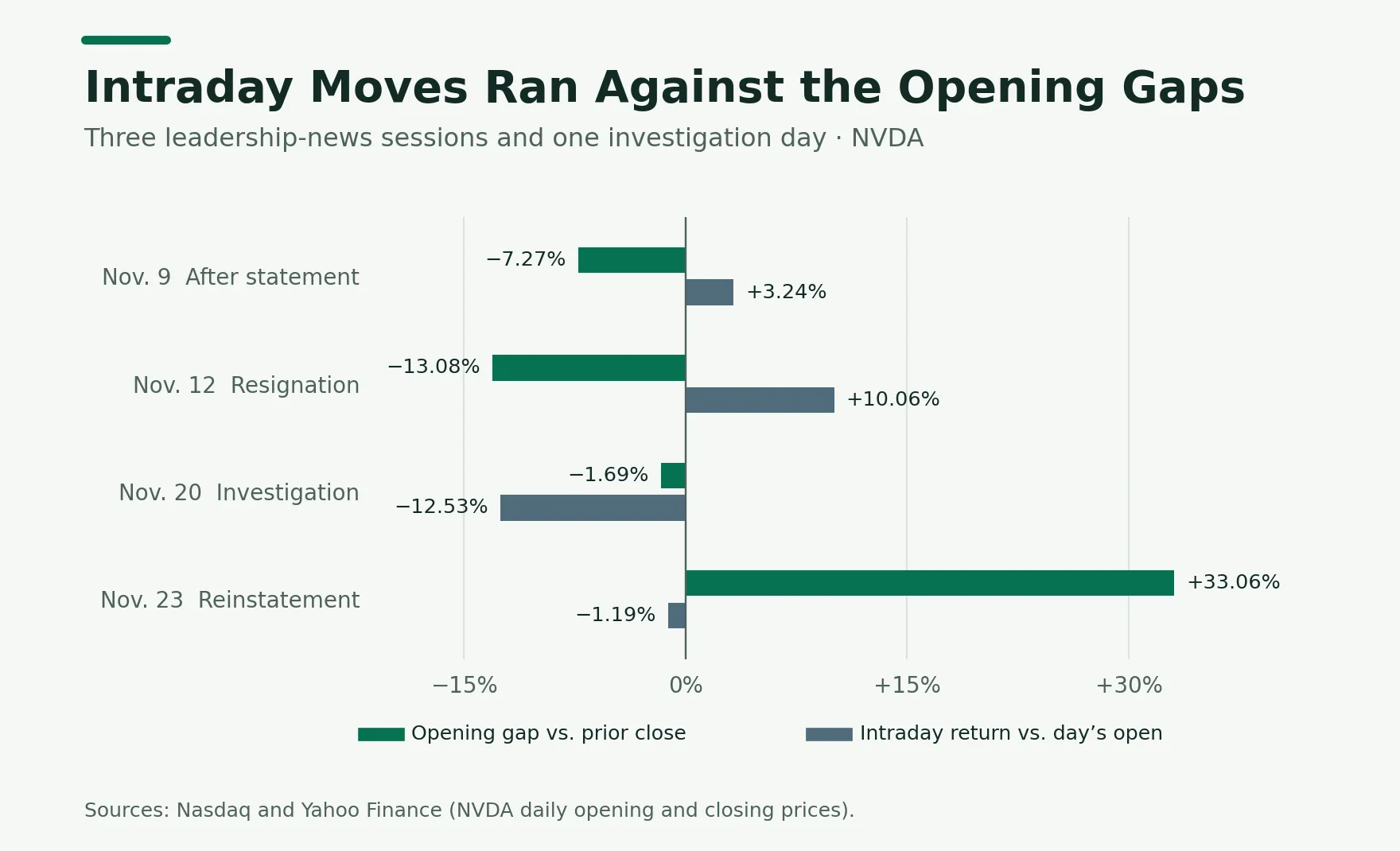
NVIDIA opened 7.27% lower after Huang’s statement and 13.08% lower on the resignation announcement, then rebounded from each opening price. On November 23, it opened 33.06% above the prior close and slipped 1.19% during the regular session. MoveSurge recorded a jump from $136.00 to $164.19 in about ten minutes after the reinstatement news appeared in its premarket feed. Nasdaq historical prices · MoveSurge premarket timeline
VandaTrack estimates retail investors bought a net $111 million in the first 30 minutes of trading on November 12, more than 40 times a typical opening, and $474 million over the full session. NVDA closed 4.34% lower that day. The retail flow estimate shows buying into the decline. It cannot identify who was selling or how much retail trading drove the price. VandaTrack flow analysis
In the 48-session estimation window, only two daily absolute abnormal returns exceeded two residual standard deviations. The November volume series had seven sessions above a z-score of 2, including November 4 and 5 before Huang’s statement. High volume can flag unusual trading. Public daily price and volume data cannot identify coordinated accounts or demonstrate that institutions deliberately traded ahead of the news.
How much market value moved when Jensen Huang returned?
On November 23, NVDA gained 31.48%, while SPY gained 4.71% and SMH rose 15.03%. The stock beat those benchmarks by 26.77 and 16.45 percentage points, respectively. An event study estimates how much of NVIDIA’s return was unusual relative to its own historical relationship with those benchmarks. Yahoo Finance NVDA history · SPY history · SMH history
| U.S. trading session | NVDA return | Abnormal vs. SPY model | Abnormal vs. SPY + SMH model | SPY-model z-score |
|---|---|---|---|---|
| Nov. 9, first session after statement | −4.27% | −9.57% | −8.76% | −5.26 |
| Nov. 12, resignation announced | −4.34% | −3.58% | −3.53% | −1.97 |
| Nov. 20, investigation reported | −14.01% | −5.94% | −5.33% | −3.26 |
| Nov. 23, reinstatement announced | +31.48% | +20.97% | +19.29% | +11.52 |
The November 20 table entry uses SPY and SMH. The −6.12% result above uses SPY and a basket that explicitly excludes NVIDIA. The comparison tests whether the choice of semiconductor benchmark changes the result.
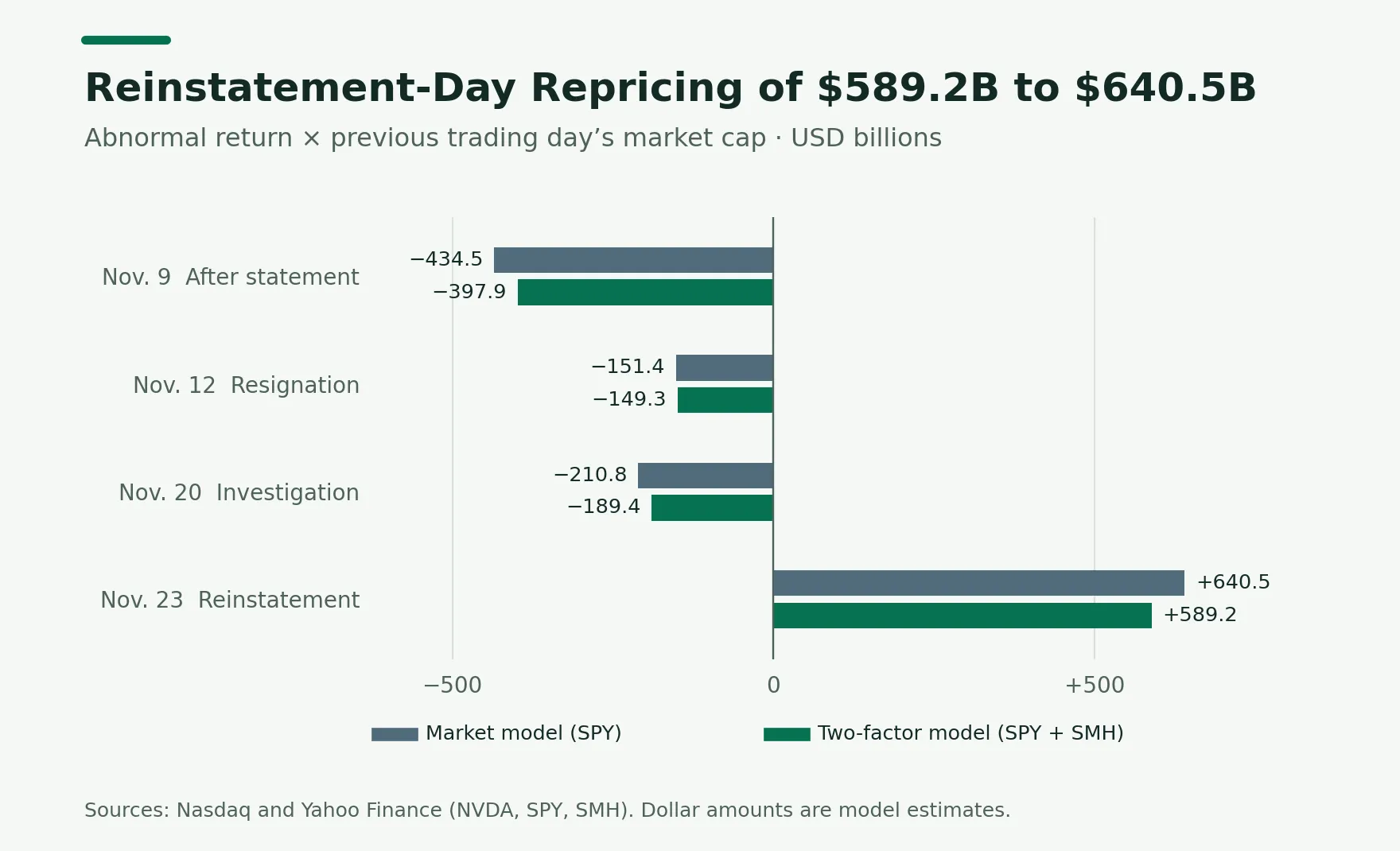
The November 9 session alone saw an estimated abnormal market-cap loss of $397.9 billion to $434.5 billion. Adding the November 12 session brings the estimated loss to $547.2 billion to $585.9 billion. The November 23 announcement coincided with an abnormal gain of $589.2 billion to $640.5 billion. Using the 24.1 billion shares NVIDIA reported as outstanding on August 21 instead of the study’s estimated 24.33 billion gives a reinstatement-day gain of roughly $584 billion to $634 billion above the models’ benchmarks. NVIDIA Form 10-Q
The cover’s $568.2 billion is the midpoint between the $547.2 billion two-day loss and the $589.2 billion return-day gain in the SPY + SMH model. It is about 3.76 times the $151.2 billion November 11 net-worth estimate used in the original study. That comparison puts the size of the moves in perspective. The residual can include other company-specific news and positioning, and one event study cannot isolate Huang’s personal contribution. Forbes wealth estimate
Data and event study methodology
- Market data. Regular-session daily opens and closes come from Nasdaq and Yahoo Finance. Key NVDA and Intel closes were cross-checked against Stock Analysis. The equal-weight peer benchmark averages daily returns for AMD, AVGO, TSM, MU, ASML, QCOM and INTC, using split-adjusted closes from StockQuote. Nasdaq NVDA · Stock Analysis INTC
- Estimation window. The models fit 48 daily returns from August 25 through October 30, 2026, using August 24 as the first price base. The main models regress NVDA returns on SPY alone or on SPY and SMH, with an intercept. The November 20 sensitivity check uses SPY and the equal-weight semiconductor basket.
- Dollar conversion. Abnormal return equals actual return minus the model’s expected return. Multiplying it by the previous session’s closing market cap gives the abnormal market-cap change. Dollar estimates assume a constant share count. Dates and announcement windows use U.S. Eastern Time.
How we ran the analysis with DataForest and DeepSeek
The original event study was generated in DataForest with DeepSeek. For this article, we checked the announcement dates against filings, compared the benchmark specifications and cross-checked the closing prices. The workflow turns public price data into tables and charts you can inspect alongside the model assumptions. Download DataForest